Joanne's Full-Mouth Rehabilitation: Restoring Comfort and...
Clinically Reviewed by Brennan Bonati, DDS — Cosmetic & Restorative Dentistry
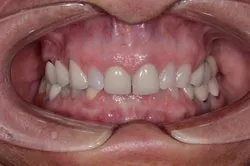
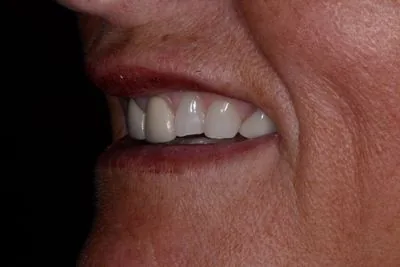
 Before
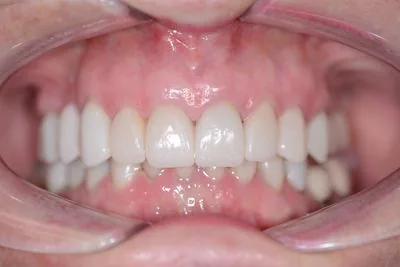
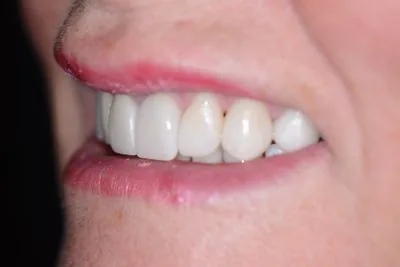
 After
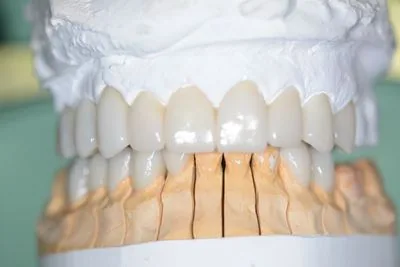
After
| Patient | Joanne, late 60s |
| Chief Complaint | Severe jaw pain from worn-down teeth; biting on lower gums |
| Treatment | 4 veneers, 12 crowns, 4 implant crowns (20 total restorations) |
| Material | E.max (lithium disilicate) |
| Bite Correction | ~5mm anterior opening, 2–3mm posterior opening |
| Investment Range | $45,000 – $65,000 |
| Appointments | 7 visits over approximately 5 weeks |
| Location | Lakewood, Colorado |
| Clinical Reviewer | Dr. Brennan Bonati, DDS |
Joanne's Story
Joanne came in with a problem that went far beyond cosmetics. Over the course of decades, she had worn her teeth down so severely that she was biting directly on her lower gums. The result was constant jaw pain that affected every part of her daily life — eating was uncomfortable, speaking was difficult, and sleep had become nearly impossible. By the time she sought treatment, she had not slept through the night in months.
 Click to enlarge
Years of wear had also led to a series of dental treatments that attempted to address individual teeth but never resolved the underlying problem: Joanne's bite had collapsed. Her vertical dimension — the distance between her upper and lower jaw when the teeth are together — had been lost to the point where her teeth could no longer protect her gums from contact. She needed more than a few restorations. She needed a complete rehabilitation of her bite, her function, and her smile.
What Joanne wanted was straightforward: to be comfortable again. She wanted to eat without pain, sleep without her jaw aching, and have a natural, beautiful smile that she felt confident about. She was not looking for a Hollywood transformation — she wanted her life back.
The Treatment Plan
After a thorough consultation and records appointment, the treating dentist developed a comprehensive treatment plan to restore Joanne's vertical dimension, correct her occlusion, and give her a smile she helped design. The plan involved 20 total restorations: 4 porcelain veneers on teeth that had enough remaining structure, 12 full-coverage crowns on teeth that were too compromised for veneers alone, and 4 implant crowns to replace teeth that could not be saved.
All restorations were fabricated in E.max (lithium disilicate), chosen for its combination of strength, natural translucency, and longevity — critical factors in a case requiring this degree of bite opening.
The treatment followed a carefully sequenced process across seven appointments:
- Consultation and records — comprehensive exam, photographs, impressions, and bite records to plan the case
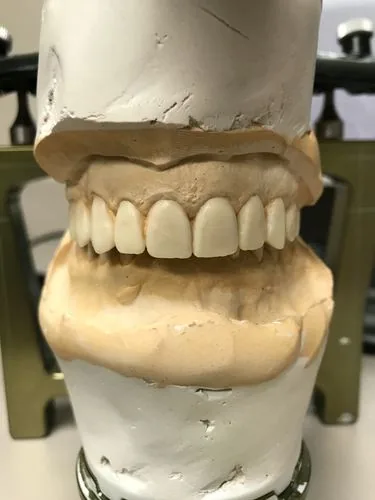
- Smile try-in — a wax-up or digital preview allowing Joanne to see and approve the proposed smile design before any tooth preparation
- Case prep day — all teeth were prepared in a single session to ensure consistency across the entire arch
- Post-prep verification — a follow-up appointment after the anesthesia wore off to check the bite and cosmetics when Joanne's lip was not numb, ensuring everything felt natural
- Temporary wear period — approximately three weeks in provisional restorations while the dental laboratory fabricated the final E.max restorations. This phase was critical: all bite adjustments, cosmetic refinements, and comfort issues were resolved in the temporaries before committing to the final porcelain
- Delivery day — the final E.max restorations were bonded
- Post-delivery and night guard — a final appointment to verify the bite, take impressions for a protective night guard, capture final photographs, and deliver the night guard
Equilibration — the precise adjustment of how the upper and lower teeth contact each other — was performed as needed throughout the process to ensure a balanced, stable bite that would protect the restorations long-term.
 Click to enlarge
Clinical Insight
Joanne's case was one of the most clinically demanding types of restorative work a dentist can perform. Opening a patient's bite by approximately 5 millimeters in the anterior and 2 to 3 millimeters in the posterior is a significant change to the entire masticatory system — the jaw joints, the muscles, and the way every tooth contacts its opposing surface all have to adapt to a new position.
The key to managing a case like this is the temporary phase. The provisionals are not just placeholders while the lab works — they are the testing ground for every decision in the case. Bite position, vertical dimension, cosmetics, phonetics, and comfort are all evaluated and refined in the temporaries. If something is not right, it is far easier and less costly to adjust an acrylic temporary than to remake porcelain. By the time the final E.max restorations are fabricated, they are based on a proven design that the patient has already been living with comfortably.
The accuracy of the initial bite records was absolutely critical in this case. With a 5-millimeter opening, even small errors in the centric relation record would compound across 20 restorations and result in a bite that does not function properly. Every record had to be precise, and every adjustment in the temporary phase had to be documented so the laboratory could replicate the exact bite relationship in the final porcelain.
The Result
The night Joanne first had her temporary restorations placed was the first time she had slept through the night in months. The immediate relief from the bite correction — simply having her teeth in a position where they no longer forced her jaw into her gums — was significant before the final restorations were even made.
 Click to enlarge
The final result was a natural, beautiful smile with proper occlusion, no pain, and full function restored. Joanne could eat comfortably, speak clearly, and sleep without jaw pain. The E.max restorations provided the strength needed to withstand normal function while delivering the translucency and natural appearance of healthy teeth.
 Click to enlarge
 Click to enlarge
 Click to enlarge
 Click to enlarge
Hear From Joanne
Free Resource
Am I a Candidate? Download Your Free Guide to Find Out
The complete self-assessment checklist — good candidate indicators, pre-treatment conditions to resolve, and what to expect at your first consultation. Clinically reviewed by Brennan Bonati, DDS.
No spam. No sales call. One email with your download link.
What This Case Helps Explain
Joanne's full-mouth rehabilitation highlights the challenges of severe tooth wear and the importance of addressing bite collapse through comprehensive treatment. This case demonstrates how veneers and crowns work together to restore both function and aesthetics in patients with advanced wear. Understanding who qualifies for extensive veneer and crown treatments is crucial, especially when bite correction is involved. The investment required for such a complex case is detailed in our full mouth veneers cost guide, which helps patients plan financially. For a broader perspective, explore more transformations in our full smile makeover case gallery and learn about the step-by-step veneer procedure that supports these outcomes.
At a Glance
Decades of wear had collapsed Joanne's bite, causing severe jaw pain and gum contact. She hadn't slept through the night in months.
Veneers were the ideal choice for Joanne's four healthiest anterior teeth because they preserved maximum natural tooth structure while delivering the cosmetic transformation she needed. Unlike crowns, which require removing tooth structure from all sides, veneers bond to the front surface only — keeping the tooth stronger long-term. For the remaining teeth with more extensive damage, crowns and implant crowns were necessary, but the veneers anchored the aesthetic result with a natural, translucent appearance that matched the surrounding restorations perfectly.
20 total restorations (4 veneers, 12 crowns, 4 implant crowns) in E.max with ~5mm bite opening.
Complete pain relief, restored function, and a natural smile. Joanne slept through the night for the first time in months after temporary placement.
Related Reading
- How Much Do Veneers Cost? The Complete Guide — understand all the factors that affect pricing for cases like Joanne's
- Types of Veneers: Porcelain, Composite, and E.max Compared — learn why E.max was chosen for this case
- What to Expect During the Veneer Procedure — a step-by-step guide to the process Joanne went through
- Is a Candidate for Veneers?— find out if veneers or crowns are right for the situation
- Veneer Results and Long-Term Care — what to expect after your restorations are placed
- Financing Options for Veneers — payment plans and ways to make treatment more affordable
Inspired by Joanne's Story?
I Want to Smile Like Joanne — Book My Free Consultation
Schedule a no-obligation consultation with a trusted Colorado cosmetic dentist. Most patients are seen within 1–2 weeks.
Frequently Asked Questions About Full-Mouth Rehabilitation
How long does a full-mouth rehabilitation take?
A full-mouth rehabilitation typically requires 5 to 8 appointments over 4 to 8 weeks, depending on the complexity of the case. Joanne's case involved 7 appointments over approximately 5 weeks, including a 3-week period in temporary restorations while the laboratory fabricated the final E.max porcelain. Cases requiring implant placement may take longer if healing time is needed before the final restorations can be placed.
What does it mean to "open the bite" and why is it necessary?
Opening the bite means increasing the vertical dimension of occlusion — the distance between the upper and lower jaws when the teeth are together. When teeth wear down significantly over time, this distance decreases, which can cause jaw pain, muscle fatigue, and in severe cases like Joanne's, the patient may begin biting on their own gum tissue. Restoring the proper vertical dimension relieves these symptoms and creates the space needed for restorations of adequate thickness and strength.
Why was E.max chosen over other materials?
E.max (lithium disilicate) was chosen for Joanne's case because it offers an ideal combination of strength and aesthetics. With 20 restorations spanning both arches and a significant bite opening, the material needed to withstand substantial occlusal forces while providing natural translucency and color. E.max can be pressed or milled to precise specifications, allowing the laboratory to match shade and contour across all 20 units for a seamless, natural result.
Is a night guard necessary after full-mouth rehabilitation?
Yes. A custom night guard is strongly recommended after any full-mouth rehabilitation to protect the investment. Even patients who did not previously grind their teeth may develop bruxism habits, and the forces generated during sleep can damage porcelain restorations over time. A properly fitted night guard distributes these forces evenly and significantly extends the lifespan of the restorations.
Can worn-down teeth always be saved with veneers and crowns?
Not always. The treatment plan depends on how much tooth structure remains. In Joanne's case, 4 teeth had enough healthy structure to support veneers, 12 required full-coverage crowns because more structure had been lost, and 4 teeth could not be saved at all and were replaced with implant crowns. A thorough evaluation with records, X-rays, and a clinical exam is necessary to determine which teeth can be preserved and which need to be replaced.
Find Veneers Near You
All three documented cases were treated in the Denver metro area. If veneers are being considered, cost and provider information for the respective city should be explored:
Not in Colorado? Browse all locations →
Explore More Cases
Each case below includes a full clinical breakdown with before-and-after documentation.