David's Smile Reconstruction: Replacing Missing Teeth with Implant...
Clinically Reviewed by Brennan Bonati, DDS — Cosmetic & Restorative Dentistry
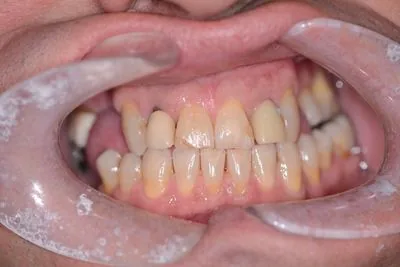
 Before
 After
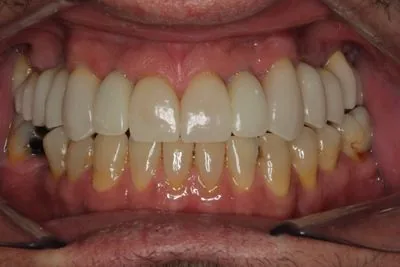
After
| Patient | David, late 40s |
| Chief Complaint | Multiple missing teeth (6 total); edge-to-edge bite; poor smile aesthetics |
| Treatment | 5 implant crowns (including one double-unit), 6 crowns (12 total restorations) |
| Material | E.max (lithium disilicate) |
| Bite Correction | Anterior repositioning to correct edge-to-edge relationship; no vertical opening |
| Investment Range | $45,000 – $65,000 |
| Location | Lakewood, Colorado |
| Clinical Reviewer | Dr. Brennan Bonati, DDS |
David's Story
David had been living with missing teeth for years. Six teeth were gone — some lost to decay, others to fracture — and the gaps had taken a toll on both his appearance and his function. Eating certain foods was difficult, and he had become self-conscious about smiling in professional and social settings. At 48, he decided it was time to do something about it.
But David's case was not just about replacing missing teeth. He also had an edge-to-edge bite, meaning his upper and lower front teeth met tip-to-tip instead of the upper teeth overlapping the lower teeth slightly. This bite relationship puts excessive stress on the front teeth, accelerates wear, and increases the risk of fractures — which may have contributed to the tooth loss in the first place.
 Click to enlarge
David wanted a complete solution: replace the missing teeth, fix the bite, and create a natural, beautiful smile that he felt proud of. David was actively involved in the design process, using the smile try-in and temporary phase to shape the final result.
The Treatment Plan
David's reconstruction required 12 total restorations: 5 implant crowns to replace the 6 missing teeth (one implant crown was a double-unit, replacing 2 teeth on a single implant with a pontic), and 6 crowns on the remaining natural teeth that needed restoration. All units were fabricated in E.max lithium disilicate for consistent aesthetics and strength across the entire case.
Unlike Joanne's and Brandon's cases, David did not need a vertical bite opening. Instead, his bite was repositioned forward — moving the lower jaw's resting position to establish proper overjet and overbite. This anterior repositioning corrected the edge-to-edge relationship so that the upper teeth would properly overlap the lower teeth, distributing biting forces correctly and reducing the risk of future fractures.
The implant placement was coordinated with the restorative plan from the beginning. The implant positions were determined not just by available bone, but by where the final teeth needed to be for optimal aesthetics and function. This prosthetically driven approach ensures that the implants support the teeth in exactly the right position rather than placing teeth wherever the implants happen to be.
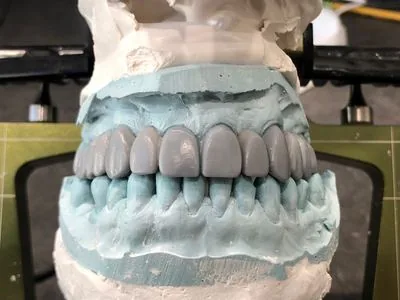
The treatment followed the same structured process: consultation and records, smile try-in for patient approval, preparation and provisionalization, a period in temporaries to verify bite, cosmetics, and comfort, delivery of the final E.max restorations, post-delivery verification, and night guard fabrication. Equilibration was performed as needed throughout to ensure balanced contacts and long-term stability.
 Click to enlarge
Clinical Insight
David's case illustrates a different type of bite challenge than a vertical opening. Repositioning the bite anteriorly — moving it forward to correct an edge-to-edge relationship — requires the dentist to establish a new position for the lower jaw that is both comfortable for the patient and biomechanically sound for the restorations. The muscles and joints have to adapt to this new position, which is why the temporary phase is so critical.
All cosmetics, bite position, and color were managed and resolved in the temporary restorations. This is the phase where problems are identified and fixed. If the patient is comfortable in the temps, if the bite is stable, if the aesthetics are right — then the finals will be right, because they are fabricated to replicate exactly what the patient has been wearing successfully. If something is not working in the temps, it is far better to discover that in acrylic than in porcelain.
The double-unit implant crown — replacing two teeth on a single implant — required careful planning to ensure the pontic (the false tooth suspended between the implant crown and the adjacent restoration) had proper emergence profile and tissue contact. The goal is for every tooth in the arch to look like it grew there naturally, whether it is a veneer on a natural tooth, a crown, or an implant-supported restoration.
The Result
David's reconstruction replaced all six missing teeth, corrected the edge-to-edge bite, and gave him a complete, natural smile for the first time in years. The E.max restorations matched seamlessly across the implant crowns and natural-tooth crowns — there is no visible difference between the teeth supported by implants and those supported by natural roots.
 Click to enlarge
The bite repositioning eliminated the edge-to-edge contact that had been putting his remaining teeth at risk, and the night guard provides ongoing protection during sleep. David can eat, speak, and smile with full confidence, knowing that every restoration was designed, tested in temporaries, and refined before the final porcelain was ever fabricated.
 Click to enlarge
Hear From David
What This Case Helps Explain
David's smile reconstruction showcases how implant crowns combined with porcelain restorations can effectively replace multiple missing teeth while correcting bite issues like an edge-to-edge relationship. This case exemplifies the principles outlined in our veneer and implant candidacy guidelines for patients requiring both functional and aesthetic rehabilitation. The financial investment for such extensive implant and veneer work is detailed in the full mouth veneers cost guide. To understand the materials used, review our porcelain veneer types page, and for a broader context, see more examples in the full smile makeover case category.
Free Resource
Am I a Candidate? Download Your Free Guide to Find Out
The complete self-assessment checklist — good candidate indicators, pre-treatment conditions to resolve, and what to expect at your first consultation. Clinically reviewed by Brennan Bonati, DDS.
No spam. No sales call. One email with your download link.
At a Glance
David was missing 6 teeth and had an edge-to-edge bite that compromised both function and appearance.
In David's case, veneers played a strategic role in the overall reconstruction. For the teeth that were structurally sound but cosmetically compromised by years of edge-to-edge contact, veneers allowed the clinical team to reshape the smile line and correct tooth proportions without the aggressive preparation required for full crowns. This conservative approach preserved David's remaining healthy tooth structure while the implant crowns replaced what was already lost — creating a cohesive result where every restoration, whether veneer, crown, or implant crown, worked together as a unified system.
12 total restorations (5 implant crowns including one double-unit, 6 crowns) in E.max.
Complete smile reconstruction with all missing teeth replaced, corrected bite relationship, and natural aesthetics throughout.
Considering a similar smile transformation?
The estimator tool provides a personalized cost range based on the number of teeth, material, and case complexity — the same factors that determined the treatment plan in this case.
Get a Personalized Cost Estimate →Related Reading
- How Much Do Veneers Cost? The Complete Guide — understand pricing for complex restorative cases
- Veneers vs. Dental Implants — when each option is appropriate and how they work together
- Veneers vs. Crowns — understanding when a veneer is sufficient and when a crown is needed
- What to Expect During the Veneer Procedure — the step-by-step process for restorative cases
- Is a Candidate for Veneers?— how missing teeth and bite issues affect options
- Veneer Results and Long-Term Care — maintaining your restorations for maximum longevity
Inspired by David's Story?
I Want to Smile Like David — Book My Free Consultation
Schedule a no-obligation consultation with a trusted Colorado cosmetic dentist. Most patients are seen within 1–2 weeks.
Not Every Patient Is a Candidate
The outcome shown in this case reflects a specific clinical situation. Results vary based on the patient's existing tooth structure, gum health, bite, and compliance with post-treatment care. Patients with active gum disease, insufficient enamel, or severe bruxism may not be candidates for veneers without first addressing those conditions. A thorough clinical evaluation — including X-rays, bite analysis, and periodontal assessment — is required before any treatment plan is finalized.
Frequently Asked Questions About Implants and Smile Reconstruction
Can dental implants and veneers be used in the same case?
Yes, and they frequently are. In cases where some teeth are missing and others need cosmetic or structural restoration, implant crowns replace the missing teeth while veneers or crowns restore the remaining natural teeth. The key is using the same material — in David's case, E.max — across all restorations so the color, translucency, and surface texture match seamlessly. A well-planned case should make it impossible to tell which teeth are implant-supported and which are natural.
What is an edge-to-edge bite and why is it a problem?
An edge-to-edge bite occurs when the upper and lower front teeth meet tip-to-tip instead of the upper teeth overlapping the lower teeth slightly. This bite relationship concentrates forces on the edges of the teeth, which are not designed to bear that load. Over time, this leads to chipping, cracking, excessive wear, and in some cases, tooth loss. Correcting an edge-to-edge bite during a restorative case involves repositioning the bite so the upper teeth properly overlap the lower teeth, distributing forces more safely.
How long do dental implants last?
The implant itself — the titanium post placed in the jawbone — can last 15–20 years with proper care with proper care. The implant crown (the visible tooth attached to the implant) typically lasts 15 to 25 years before it may need replacement due to normal wear. Factors that affect longevity include oral hygiene, regular dental visits, night guard use (if applicable), and the quality of the initial placement and restoration. David's E.max implant crowns are designed for long-term durability.
What is a double-unit implant crown?
A double-unit implant crown replaces two adjacent missing teeth using a single implant. One tooth is directly supported by the implant (the implant crown), and the second tooth is a pontic — a false tooth that is attached to the implant crown and suspended over the gum tissue. This approach reduces the number of implants needed and is used when bone quality or spacing makes placing two separate implants impractical. The pontic is contoured to look and feel like a natural tooth emerging from the gum.
Why is the temporary phase so important in reconstruction cases?
The temporary phase is where every critical decision in the case is tested and validated before committing to the final porcelain. Bite position, vertical dimension, tooth shape, size, color, and patient comfort are all evaluated in the provisionals. If something needs to change, it is far easier and less costly to adjust an acrylic temporary than to remake porcelain. The finals are fabricated to replicate exactly what the patient has been wearing successfully in the temporary phase, which is why the temps must be right before the lab begins the final restorations.
Find Veneers Near You
All three documented cases were treated in the Denver metro area. If veneers are being considered, cost and provider information for the respective city should be explored:
Not in Colorado? Browse all locations →
Explore More Cases
Each case below includes a full clinical breakdown with before-and-after documentation.