Both porcelain veneers and dental bonding can fix chips, gaps, and discoloration — but they're fundamentally different treatments with different trade-offs. This guide breaks down exactly when each option makes sense, what they cost, and how long they last, so you can walk into a consultation with clarity.
Veneers vs. Bonding: The Comparison
| Factor | Porcelain Veneers | Dental Bonding |
|---|---|---|
| Best For | Multiple teeth, comprehensive smile changes, long-term results | Single tooth, minor chips, small gaps, quick fixes |
| Cost Per Tooth | $900 – $2,500 | $300 – $600 |
| Lifespan | 15 – 20+ years | 3 – 7 years (then replacement needed) |
| Stain Resistance | Excellent — porcelain resists coffee, wine, tea | Poor — composite absorbs stains over time |
| Tooth Prep Required | Minimal enamel removal (0.3–0.5mm) | None — fully reversible |
| Appointments | 2 visits over 2–3 weeks | 1 visit (30–60 minutes per tooth) |
| Appearance | Highly natural — mimics real enamel translucency | Good initially — color match degrades with age |
| Durability | Very strong — resistant to chipping | Moderate — more prone to chipping than porcelain |
For a full cost breakdown including payment plans and financing, see the complete cost guide.
When Bonding Is the Right Choice
Bonding has a legitimate clinical role. For isolated repairs — a chipped incisal edge, a small gap between two teeth, a minor shape irregularity on one tooth — composite bonding is faster, less expensive, and requires no tooth reduction. In these cases, it is often the most appropriate treatment.
The practical decision rule: choose bonding for isolated, minor corrections where longevity is less critical. Choose porcelain veneers for comprehensive smile changes where color stability, durability, and long-term aesthetics are the priority.
When Veneers Are the Better Option
The limitations of bonding become apparent in more comprehensive cases. Composite stains over time, particularly in patients who drink coffee, tea, or red wine. It is also more susceptible to chipping than porcelain, and the color match between composite and natural tooth structure degrades as the composite ages.
For patients seeking a comprehensive smile change — multiple teeth, significant color correction, or a result expected to last 15–20 years — composite bonding is not the appropriate material. Porcelain veneers provide superior color stability, durability, and long-term aesthetics. Understanding the veneer procedure can help you decide if you're ready for that commitment.
Many patients start with composite bonding as a trial or interim solution and transition to porcelain veneers when they are ready for a permanent result. Since bonding requires no enamel removal, it preserves all your future options.
Real Porcelain vs. Composite Cases
See the difference for yourself. Hannah chose porcelain veneers for a comprehensive smile change. Lexi chose composite veneers for a conservative, budget-friendly fix.
Hannah — 10 Porcelain Veneers for Crooked, Short Teeth
 Before
 After
After
Hannah wanted a longer, straighter, naturally whiter smile. 10 E.max porcelain veneers on her upper arch — completed in 5 appointments. Investment: $18,000. This is what a standard porcelain veneer case looks like.
View Hannah's full case →Lexi — Composite Veneers for Small Teeth
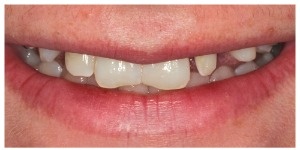 Before
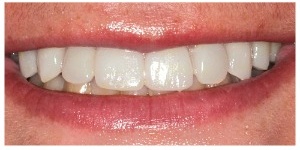 After
After
Lexi had microdontia (naturally small teeth) and chose composite veneers to add length and width. 6 composite veneers gave her a natural-looking result at a fraction of the porcelain cost ($2,500–$5,000).
View Lexi's full case →I Understand My Options — Now What?
You know the difference. Here's how to take the next step.
Frequently Asked Questions
For a small, isolated chip on a low-stress tooth, dental bonding is often the better choice — it’s faster, cheaper, and requires no enamel removal. For a deeper look at this scenario, see our guide on veneers for chipped teeth. For larger chips on front teeth where appearance matters most, or when you want a result that lasts 15+ years without staining, a porcelain veneer is the stronger option. The deciding factors are chip size, tooth location, and how long you want the repair to last.
Dental bonding typically costs $300–$600 per tooth, while porcelain veneers range from $900–$2,500 per tooth. However, bonding needs replacement every 3–7 years on average, while porcelain veneers last 15–20 years. Over a 20-year period, bonding can actually cost more due to repeated replacements. For a single tooth, bonding is clearly cheaper upfront. For multiple teeth or a long-term solution, veneers often provide better value.
Yes — this is actually a common and clinically sound approach. Bonding requires no enamel removal, so it preserves all your options for the future. Many patients use bonding as a trial or interim solution to test a cosmetic change before committing to porcelain veneers. When you're ready to upgrade, the bonding is simply removed and replaced with a veneer. Your dentist can even use the bonding shape as a preview of what veneers would look like.