How veneers can correct microdontia and create proportional, natural-looking teeth.
Understanding veneers for small teeth is an important part of your veneer research. This guide covers what you need to know, based on current clinical evidence and real patient outcomes. For a real-world example, explore Tricia's before and after results.
Nikki — Microdontia (Naturally Small Teeth)
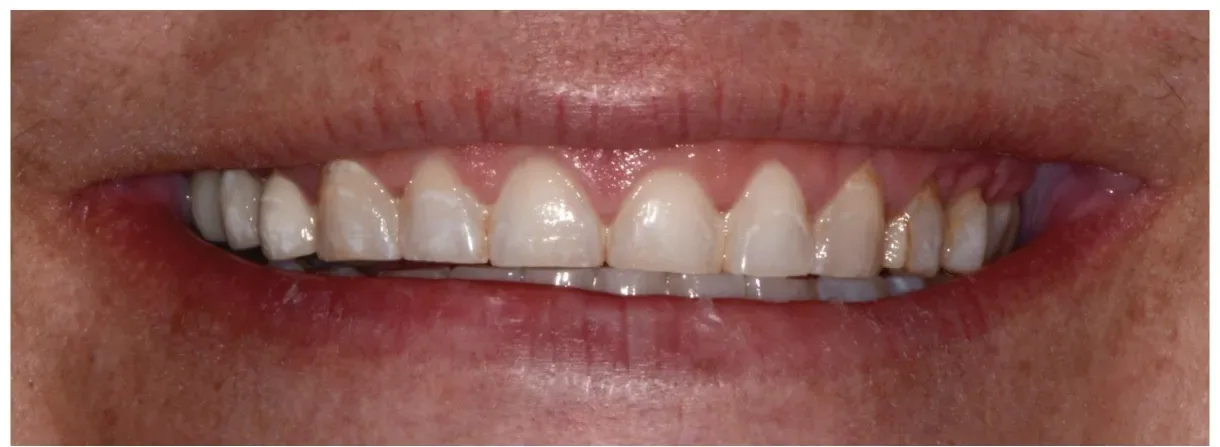
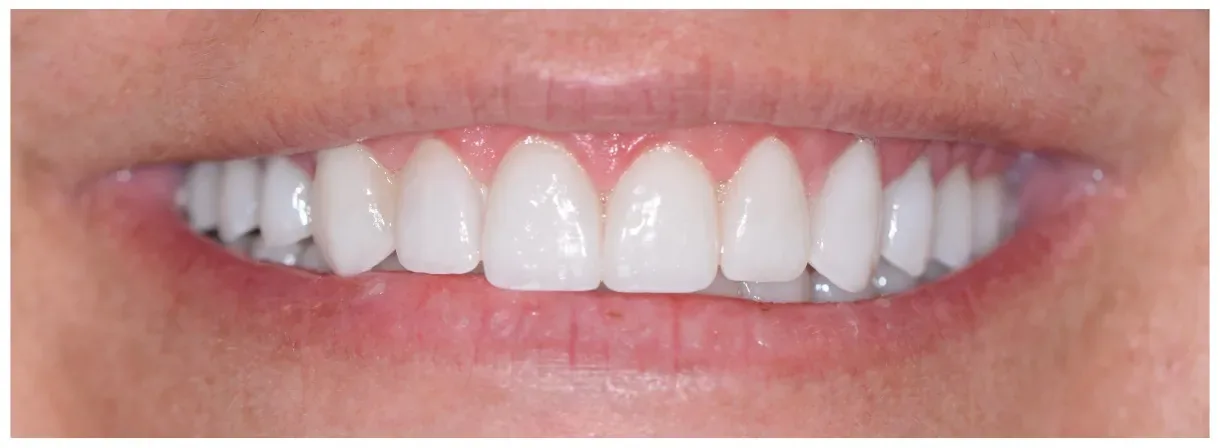
Before
After
Proportionally small lateral incisors corrected with 8 E.max veneers.
Read the full case →
In cosmetic dentistry practice, the golden proportion—approximately 62%—guides the relative widths of maxillary anterior teeth to achieve natural esthetics. Specifically, each tooth should appear about 62% the width of the adjacent tooth moving distally. For patients with small or peg-shaped teeth, simply enlarging teeth arbitrarily often disrupts this balance, resulting in a smile that looks bulky or artificial. Overly wide central incisors or lateral incisors that do not follow the 1:0.62:0.38 ratio can cause visual disharmony and affect lip support. Patients should understand that meticulous adherence to these proportional guidelines helps ensure veneers look harmonious and natural, rather than just “bigger teeth.”
Many patients considering veneers have questions about veneers for small teeth, including the cost of veneers. The information below is clinically reviewed by Brennan Bonati, DDS, and reflects current best practices in cosmetic dentistry.
Challenge: Severe grinding had worn his teeth to the point where they looked disproportionately small.
Treatment: 24 porcelain veneers and crowns to restore proper tooth height and proportion.
Outcome: Full smile restored with correctly proportioned teeth and a corrected bite.
See Brandon's Case → View Full Case StudyMost patients's situation is unique. The guidance provided here is general in nature and should not replace a consultation with a qualified cosmetic dentist who can evaluate your specific case, such as when searching for veneers near you. Factors like your bite, the condition of your existing teeth, and your overall oral health all play a role in determining the best treatment approach.
If readiness to explore whether veneers are the right option is established, the free veneers cost estimator can provide a personalized cost range in under two minutes. The provider directory can also be browsed to find vetted cosmetic dentists in the area and to view before and after veneers photos to see real results.
Veneers are not a universal solution. They require sufficient enamel for bonding, a stable bite, and healthy gum tissue. Patients with active periodontal disease, severe bruxism, or significant misalignment may need to address those conditions first — or may be better served by orthodontics, crowns, or other restorations. The information on this page is educational and does not substitute for a clinical evaluation by a licensed dentist.
Peg laterals — congenitally small lateral incisors — are one of the clearest indications for veneers or crowns. Because the tooth is present but undersized, a veneer or crown can build it out to the correct proportion without any tooth reduction. In fact, peg laterals often require no preparation at all — the veneer is bonded directly to the existing enamel surface to add volume and achieve the correct shape.
Generalized microdontia — where all teeth are proportionally small — presents a more complex treatment planning challenge. Simply making each tooth larger in isolation can result in a smile that looks artificial if the proportions between teeth are not carefully designed. The diagnostic wax-up is essential in these cases to establish the correct width-to-height ratios and the relationship between the upper and lower arches before any preparation begins.
For younger patients (under 18–19) with small teeth, composite veneers are often used as an interim solution while the patient finishes growing. Once skeletal growth is complete and the gum levels have stabilized, the composite can be replaced with permanent porcelain restorations. This approach avoids irreversible tooth preparation on a patient whose tooth and gum positions may still change.
Veneers for small teeth typically produce dramatic improvements because the transformation is so visible. Patients go from teeth that appear too small for their face to a proportional, confident smile. The key is working with a ceramist who understands facial proportions and can design veneers that look natural at the new, larger size — not like oversized chiclets. See our before and after gallery for examples.
Yes — this is one of the most common and effective uses of veneers. For patients with microdontia (naturally small teeth), veneers add length and width to create proportional, natural-looking teeth. The ceramist designs each veneer to achieve ideal tooth-to-tooth proportions and a balanced smile line. See Lexi's case for a real example.
Most patients with microdontia need 6–10 veneers to create a uniform, proportional smile. The exact number depends on how many teeth are visible when you smile and how much size discrepancy exists. Your dentist will design a treatment plan during your consultation. For cost estimates, use our free estimator.
Lumineers can work well for small teeth because the added thickness is actually beneficial rather than problematic. Since small teeth need to be built up rather than reduced, the no-prep approach of Lumineers avoids removing enamel that's already limited. However, traditional veneers still offer superior aesthetics and customization for most patients.