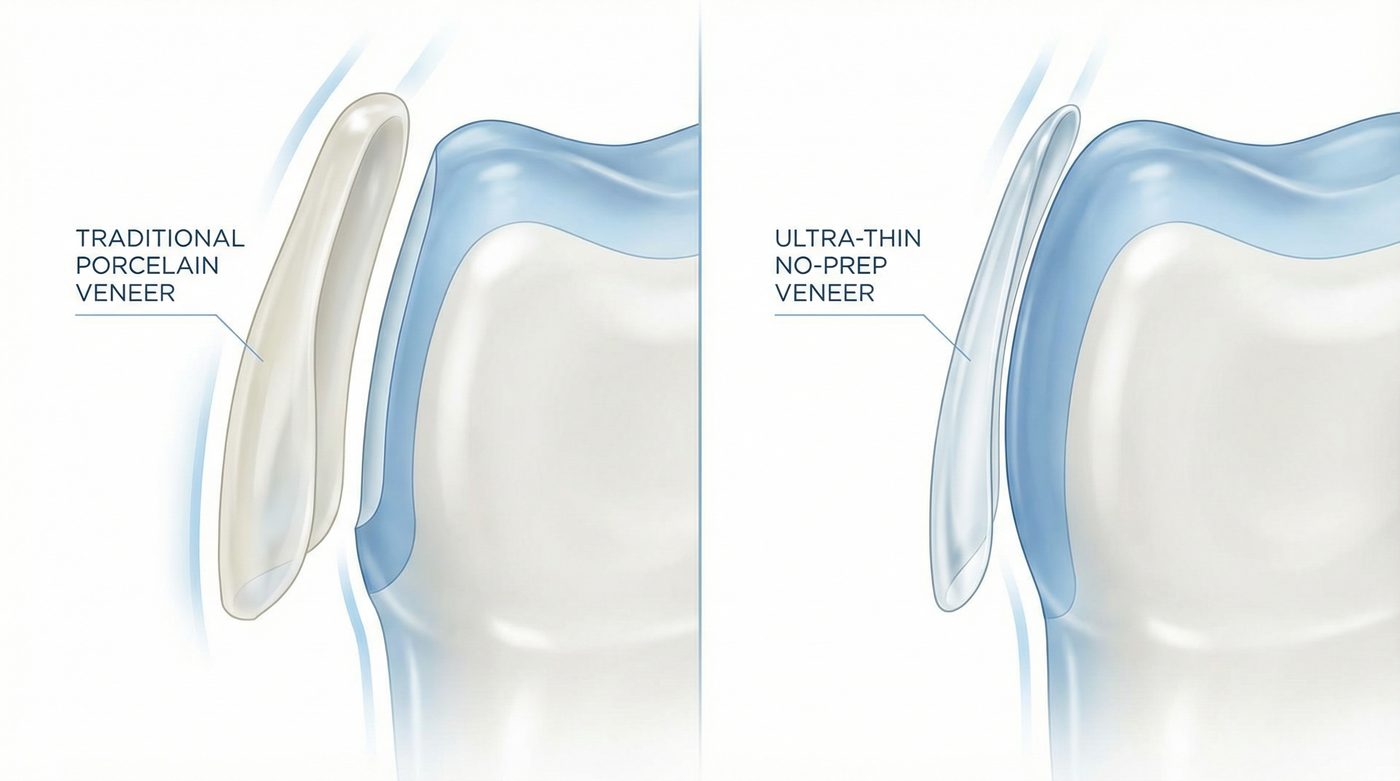
Lumineers are marketed as a no-prep alternative to traditional veneers — but the differences in thickness, appearance, and candidacy are more nuanced than the advertising suggests.
Lumineers ($800–$2,000/tooth) are ultra-thin no-prep veneers that require little to no enamel removal and are marketed as reversible. Traditional porcelain veneers ($900–$2,500/tooth) are slightly thicker, require light enamel reduction, and typically deliver more natural-looking results for patients with larger or darker teeth. For most full smile makeovers, experienced cosmetic dentists prefer traditional veneers. Lumineers are a good option for patients with thin teeth, minor corrections, or those who want to preserve maximum tooth structure.
The table below compares traditional porcelain veneers to Lumineers across the factors that matter most to patients considering a smile makeover.
| Factor | Traditional Veneers | Lumineers |
|---|---|---|
| Thickness | 0.5 – 0.7mm | 0.2 – 0.3mm (ultra-thin) |
| Tooth preparation | Light enamel reduction required | Minimal to none |
| Reversibility | No (enamel removed) | More reversible (less prep) |
| Cost per tooth | $900 – $2,500 | $800 – $2,000 |
| Natural appearance | Superior — especially for darker teeth | Good for thin/light teeth |
| Covers severe staining? | Yes — fully opaque if needed | Partially — may show through |
| Lifespan | 10 – 20 years | 10 – 15 years |
| Availability | Any trained cosmetic dentist | Lumineers-certified dentists only |
| Best for | Full makeovers, darker/larger teeth | Thin teeth, minor corrections, reversibility |
Traditional veneers win on appearance and versatility. Lumineers win on tooth preservation and reversibility.
Lumineers are a registered brand of ultra-thin porcelain veneers manufactured by Den-Mat Holdings. They are fabricated from a proprietary porcelain called Cerinate, which allows them to be made as thin as 0.2mm — roughly the thickness of a contact lens — without sacrificing strength.
Because of their extreme thinness, Lumineers can often be placed directly over existing teeth without grinding down the enamel. This is the primary marketing claim: a "no-drill, no-shot" veneer experience.
Lumineers are a brand, not a category. "No-prep veneers" is the broader clinical term. Several other brands (Vivaneers, DURAthin) offer similar ultra-thin no-prep options. The clinical considerations are the same regardless of brand.
This is the most meaningful technical difference between the two options. Traditional porcelain veneers are 0.5–0.7mm thick. To ensure a natural fit and bite, the dentist removes approximately 0.3–0.7mm of enamel from the front surface of the tooth before bonding the veneer.
Lumineers are 0.2–0.3mm thick — thin enough that they can often be bonded directly over the existing tooth without any enamel removal. This preserves more natural tooth structure and makes the procedure more reversible.
Because Lumineers are placed over unmodified teeth, they add thickness to the tooth. On patients with naturally large or prominent teeth, this can result in a bulky, "chiclet" appearance. Experienced cosmetic dentists often prefer traditional veneers for this reason, particularly for patients who want the most natural-looking result.
The table below compares the average cost of traditional veneers and Lumineers in 2026 across common treatment sizes.
| Treatment Scope | Traditional Veneers | Lumineers |
|---|---|---|
| Per tooth | $900 – $2,500 | $800 – $2,000 |
| 4 front teeth | $3,600 – $10,000 | $3,200 – $8,000 |
| Social Six (6 teeth) | $5,400 – $15,000 | $4,800 – $12,000 |
| Full smile (10 teeth) | $9,000 – $25,000 | $8,000 – $20,000 |
Lumineers are modestly less expensive than traditional veneers, but the gap is smaller than many patients expect. The more important factor is candidacy — not all patients are good candidates for Lumineers, and placing them on the wrong patient can produce a less attractive result than traditional veneers.
For patients with naturally thin, small, or light-colored teeth, Lumineers can look excellent — natural, translucent, and indistinguishable from traditional veneers. For patients with larger teeth, darker staining, or significant color correction needs, traditional veneers typically deliver superior aesthetics.
The key variables are:
Choose traditional veneers when you want the most natural-looking, longest-lasting result — especially if you have darker teeth, larger teeth, or need significant color correction. Traditional veneers give your dentist more control over the final appearance.
Choose Lumineers when tooth preservation is a priority, your teeth are naturally thin or light-colored, you want a more reversible option, or you are correcting minor imperfections rather than doing a full smile transformation.
Ask your dentist: Any cosmetic dentist who offers both options should be able to show you digital mock-ups of both treatments on your specific teeth before you commit. If a dentist pushes one option without discussing the other, ask why.
Use our free cost estimator to understand what veneers or Lumineers would cost for your specific situation — reviewed by a licensed DDS.
Start My Free Estimate →Veneer pricing varies significantly by market. See what patients in these cities are paying in 2026.
Answer 6 quick questions and get a personalized cost estimate and candidacy assessment — reviewed by a licensed DDS.
Start Free Estimate →