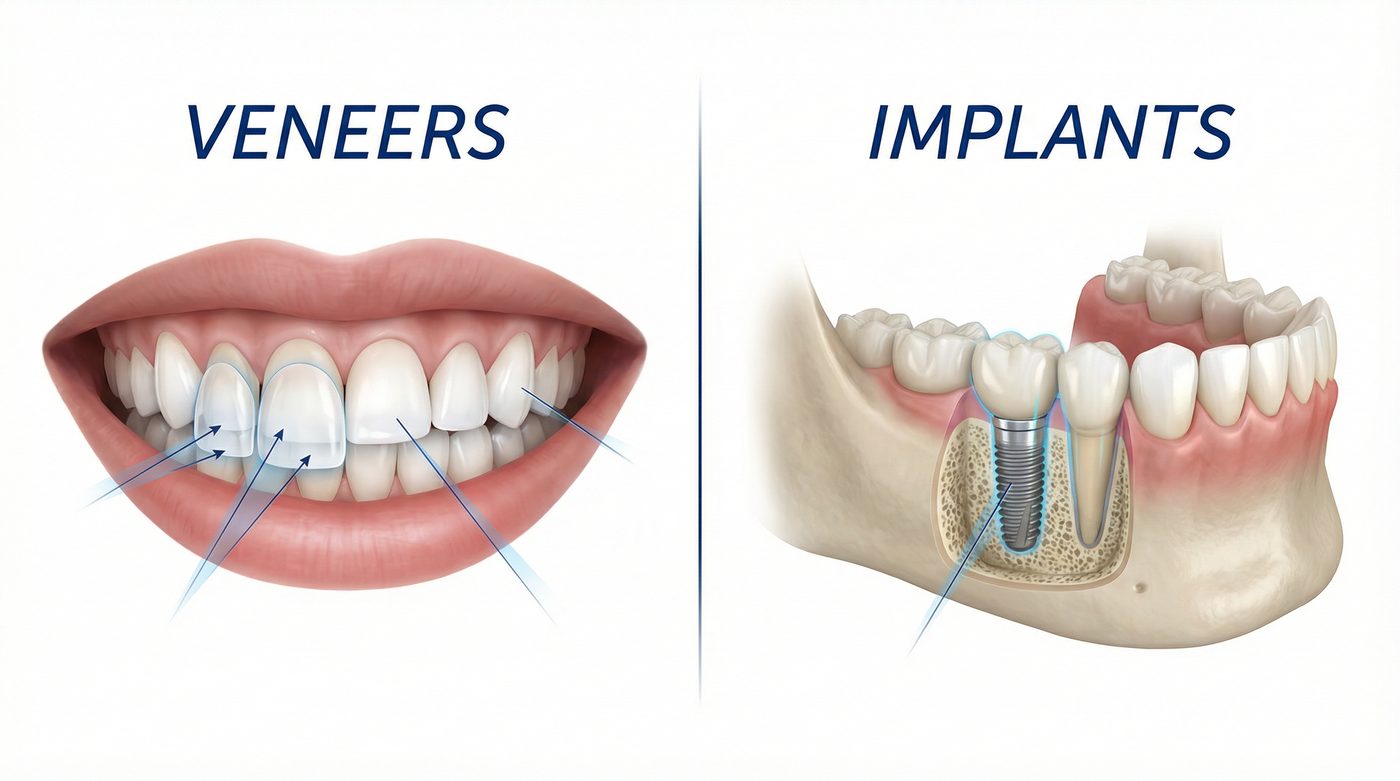
These two treatments are often confused — but they solve completely different problems. Here is how to understand which one applies to your situation.
Veneers ($900–$2,500/tooth) improve the appearance of teeth that are already present. Implants ($3,000–$6,000/tooth) replace teeth that are missing. These treatments are not alternatives to each other — they solve different problems. If your tooth exists but looks bad, you may be a veneer candidate. If your tooth is gone, you need an implant or bridge.
The table below compares veneers and dental implants across the factors patients most commonly ask about. Note that these treatments are rarely true alternatives — the right choice depends on whether the tooth is present or missing.
| Factor | Veneer | Dental Implant |
|---|---|---|
| Purpose | Cosmetic improvement of existing tooth | Replacement of missing tooth |
| Requires existing tooth? | Yes — tooth must be present | No — replaces missing tooth |
| Procedure type | Non-surgical (bonding) | Surgical (titanium post in jaw) |
| Average cost per tooth | $900 – $2,500 | $3,000 – $6,000 |
| Recovery time | None (same day) | 3–6 months (osseointegration) |
| Lifespan | 10 – 20 years | Lifetime (post); 15–25 years (crown) |
| Insurance coverage | Rarely (cosmetic) | Sometimes (if tooth loss documented) |
| Bone preservation | No effect | Yes — stimulates jawbone |
| Can be used for smile makeover? | Yes | No |
Veneers are the clear choice for cosmetic improvement of existing teeth. Implants are the standard of care for replacing missing teeth.
A veneer is a thin porcelain or composite shell bonded to the front surface of a tooth that is already present in the mouth. Veneers improve color, shape, size, and surface texture. They require the tooth to have sufficient structural integrity — typically no more than 30% of the tooth surface should be filled or decayed.
Veneers are appropriate for:
Veneers cannot be placed on a tooth that does not exist. If a tooth has been extracted or was never present, a veneer is not an option. An implant, bridge, or partial denture would be considered instead.
A dental implant is a titanium post surgically placed into the jawbone to serve as an artificial tooth root. After a healing period of 3–6 months (osseointegration), an abutment and crown are attached to complete the restoration. The result looks and functions like a natural tooth.
Implants are appropriate for:
Implants require adequate bone density. Patients who have been missing a tooth for several years may have experienced bone resorption and may need a bone graft before an implant can be placed, adding cost and treatment time.
The table below compares the average cost of veneers and implants in 2026. These costs reflect the full treatment — not just the component parts.
| Treatment | Average Cost | What Is Included |
|---|---|---|
| Porcelain veneer (per tooth) | $900 – $2,500 | Prep, lab fabrication, bonding |
| Composite veneer (per tooth) | $300 – $800 | Same-day chairside application |
| Single dental implant | $3,000 – $6,000 | Post, abutment, crown |
| Implant + bone graft | $4,500 – $8,000 | Post, graft, abutment, crown |
| Social Six veneers (6 teeth) | $5,400 – $15,000 | Full upper smile transformation |
| Full arch implants (All-on-4) | $20,000 – $40,000 | 4 implants + full arch prosthesis |
Veneers are significantly less expensive per tooth, but they serve a fundamentally different purpose. Comparing the cost of a veneer to an implant is only relevant if a tooth is present but severely damaged — in which case the dentist must determine whether the tooth is worth restoring or should be extracted and replaced.
Choose veneers when your teeth are present and structurally sound but cosmetically imperfect. Veneers are the right choice for smile makeovers, discoloration, chips, and minor shape corrections across multiple front teeth.
Choose an implant when a tooth is missing or must be extracted due to irreparable damage. Implants are the gold standard for single-tooth replacement and preserve jawbone density in a way that bridges and dentures cannot.
The overlap case: If a tooth is severely damaged — cracked below the gumline, heavily decayed, or structurally compromised — the decision between saving it with a crown/veneer versus extracting and replacing with an implant is a clinical judgment that requires examination. Ask your dentist to walk through both scenarios including long-term cost and prognosis.
Use our free cost estimator to understand what veneers would cost for your specific situation — and whether you're a good candidate.
Start My Free Estimate →Veneer pricing varies significantly by market. See what patients in these cities are paying in 2026.
Use our free estimator to get a personalized cost estimate and candidacy assessment — reviewed by a licensed DDS.
Start Free Estimate →