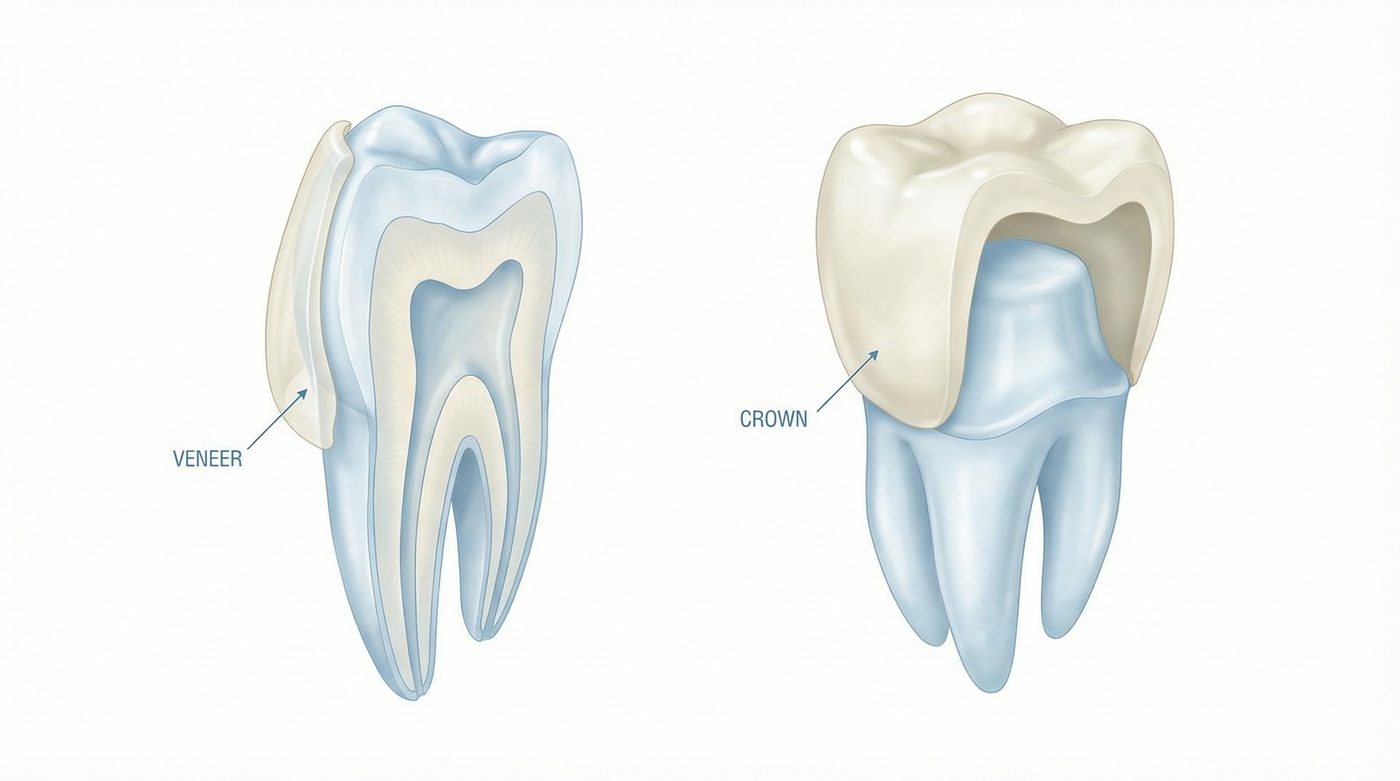
Both restore the appearance of a tooth — but they serve very different purposes. Here is how to know which one your situation actually calls for.
Veneers cover only the front surface of a tooth and are used for cosmetic improvements on structurally sound teeth. Crowns encase the entire tooth and are used when a tooth is cracked, heavily decayed, or structurally weakened. If your tooth is healthy but you dislike its color, shape, or size — veneers. If your tooth has structural damage or a large existing filling — crown.
| Factor | Veneer | Crown |
|---|---|---|
| Coverage | Front surface only | Entire tooth (all surfaces) |
| Tooth reduction | 0.3–0.7mm (minimal) | 1.5–2mm (significant) |
| Primary purpose | Cosmetic improvement | Structural restoration |
| Cost per tooth | $900 – $2,500 | $1,000 – $3,500 |
| Lifespan | 10 – 20 years | 10 – 15 years |
| Insurance coverage | Rarely covered | Often covered (if restorative) |
| Best candidate | Structurally sound tooth | Damaged, cracked, or heavily filled tooth |
| Reversible? | No | No |
A veneer is a thin porcelain or composite shell bonded to the front (labial) surface of a tooth. It improves appearance — color, shape, size, and surface texture — without altering the back or sides of the tooth.
Veneers are appropriate when:
Veneers are not appropriate for teeth with active decay, gum disease, or significant structural compromise. A thorough examination is required before any veneer placement.
A dental crown is a cap that fits over the entire visible portion of a tooth above the gumline. It restores both the appearance and the structural integrity of a tooth that has been weakened by decay, fracture, or previous dental work.
Crowns are necessary when:
This is where the two treatments diverge most significantly. A veneer requires the removal of approximately 0.3–0.7mm of enamel from the front surface — a minimal amount that preserves most of the natural tooth. A crown requires reducing the tooth by 1.5–2mm on all sides, removing a substantial portion of natural tooth structure that can never be replaced.
Once a tooth is prepared for a crown, it will always need a crown. The reduction is irreversible. This is why it is critical to confirm with your dentist whether a crown is truly necessary before proceeding, or whether a veneer or onlay might preserve more tooth structure.
The table below compares the average cost per tooth for veneers and crowns in 2026, along with insurance coverage and financing considerations.
| Factor | Veneer | Crown |
|---|---|---|
| Average cost per tooth | $900 – $2,500 | $1,000 – $3,500 |
| Social Six (6 teeth) | $5,400 – $15,000 | $6,000 – $21,000 |
| Insurance coverage | Rarely (cosmetic) | Often (if restorative) |
| HSA/FSA eligible | Sometimes | Yes (if restorative) |
| Lifespan | 10–20 years | 10–15 years |
Crowns may cost more but are often partially covered by insurance when placed for structural reasons. Veneers are almost never covered by insurance as they are classified as cosmetic.
Choose a veneer when your tooth is structurally healthy and you want to improve its cosmetic appearance — color, shape, or size. Veneers are the right choice for smile makeovers involving multiple front teeth where the underlying teeth are sound.
Choose a crown when your tooth has structural compromise that a veneer cannot address. If your dentist recommends a crown for a front tooth that appears cosmetically fine, ask whether the structural issue genuinely requires full coverage or whether a partial restoration (onlay or veneer) could achieve the same result with less tooth reduction.
Use our free cost estimator to understand what veneers would cost for your specific situation — and whether you're a good candidate.
Start My Free Estimate →Veneer pricing varies significantly by market. See what patients in these cities are paying in 2026.
Use our free estimator to get a personalized cost estimate and candidacy assessment — reviewed by a licensed DDS.
Start Free Estimate →