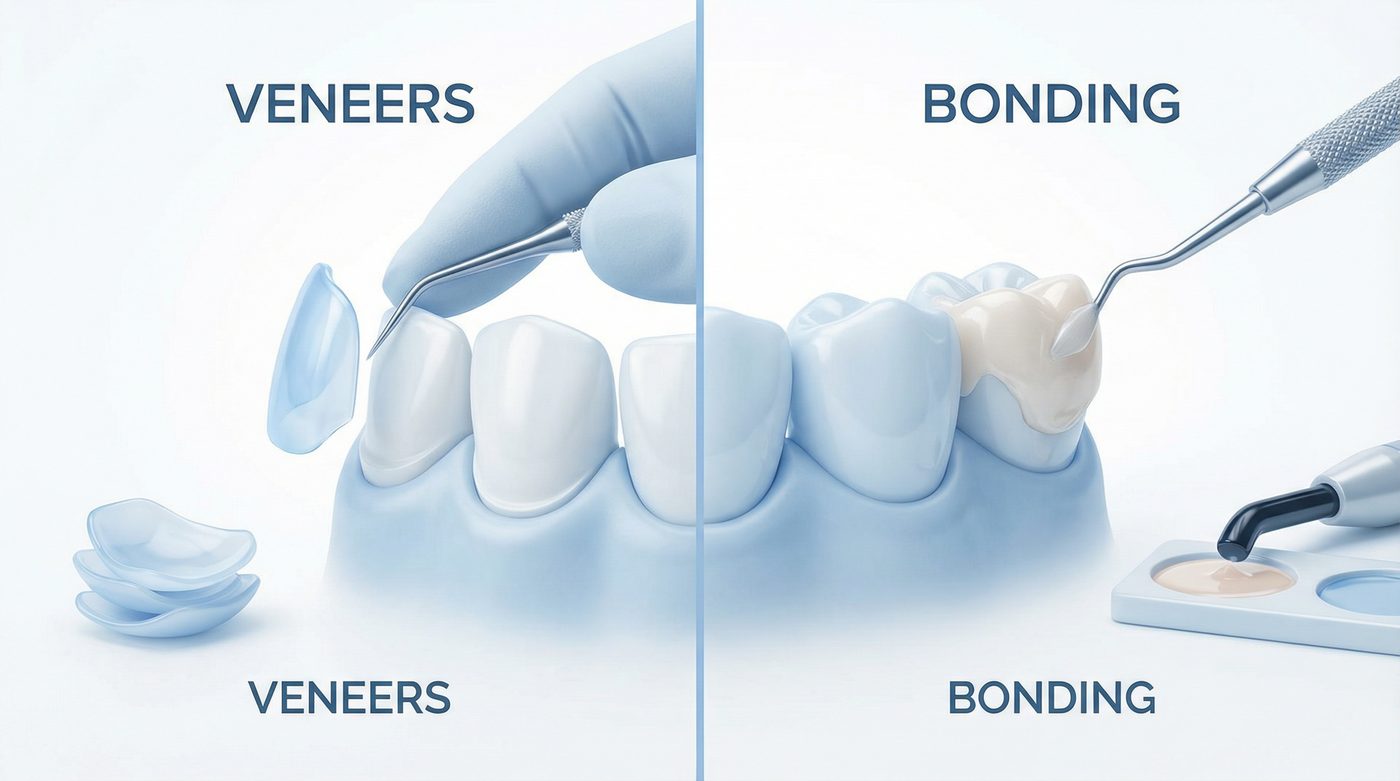
A complete side-by-side comparison — cost, durability, appearance, and a decision framework to help you choose the right treatment for your situation.
Dental bonding ($300–$600/tooth) is best for minor chips, small gaps, or patients who want a reversible, lower-cost option. Porcelain veneers ($900–$2,500/tooth) are better for full smile transformations, severe discoloration, or patients who want results that last 10–20 years. If you are correcting one or two minor imperfections, bonding is often the smarter choice. If you want a complete smile makeover, veneers deliver superior and longer-lasting results.
| Factor | Dental Bonding | Porcelain Veneers |
|---|---|---|
| Cost per tooth | $300 – $600 | $900 – $2,500 |
| Lifespan | 5 – 7 years | 10 – 20 years |
| Visits required | 1 visit (same day) | 2 visits (2–4 weeks) |
| Reversible? | Yes — minimal prep | No — enamel removed |
| Stain resistance | Moderate — stains over time | Excellent — highly resistant |
| Appearance | Good for minor corrections | Superior — natural translucency |
| Repairability | Easily repaired chairside | Must replace if chipped |
| Covers severe staining? | Partially | Yes — fully opaque if needed |
| Best for | Minor chips, small gaps, single teeth | Full smile makeovers, multiple teeth |
| Insurance coverage | Rarely covered | Rarely covered |
Dental bonding is a cosmetic procedure in which a tooth-colored composite resin is applied directly to the tooth surface, shaped by hand, and hardened with a curing light. The entire process takes 30–60 minutes per tooth and requires little to no enamel removal.
Bonding is ideal for:
Bonding resin is porous and will absorb stains from coffee, tea, and red wine over time. Patients who drink these regularly should expect to replace bonding sooner than the 5–7 year average.
Dental veneers are thin shells — typically 0.5–0.7mm thick — custom-fabricated in a dental lab and permanently bonded to the front surface of the tooth. Porcelain veneers require light enamel reduction (usually 0.3–0.7mm) to ensure a natural fit and bite.
Veneers are ideal for:
| Scenario | Bonding Cost | Veneer Cost |
|---|---|---|
| Single tooth repair | $300 – $600 | $900 – $2,500 |
| 4 front teeth | $1,200 – $2,400 | $3,600 – $10,000 |
| 6-tooth smile (top) | $1,800 – $3,600 | $5,400 – $15,000 |
| Full smile (8–10 teeth) | $2,400 – $6,000 | $7,200 – $25,000 |
Bonding typically needs replacement every 5–7 years. Over 20 years, a patient who bonds 6 teeth may spend $10,800–$21,600 in replacements — approaching or exceeding the one-time cost of porcelain veneers. Factor longevity into your decision.
Use our free cost estimator to get a personalized recommendation based on your goals, the number of teeth, and your location.
Get My Free Estimate →Veneer pricing varies significantly by market. See what patients in these cities are paying in 2026.
Use our free estimator to get a personalized cost estimate and candidacy assessment — reviewed by a licensed DDS.
Start Free Estimate →